Every ambitious entrepreneur hits the same wall: the moment you realize you need to be a salesperson, a marketer, a finance guru, and a product designer—all at once. This overwhelming pressure to achieve total mastery is a creativity killer. It leads to the classic dilemma: "I can't start until I finish training."
The good news? You don't need to master everything. You just need a framework for learning the right skills in the right order. That framework is called the T-Shaped approach, and it’s how modern founders start lean and scale smart.
The Entrepreneurial Skillset: Defining Your T
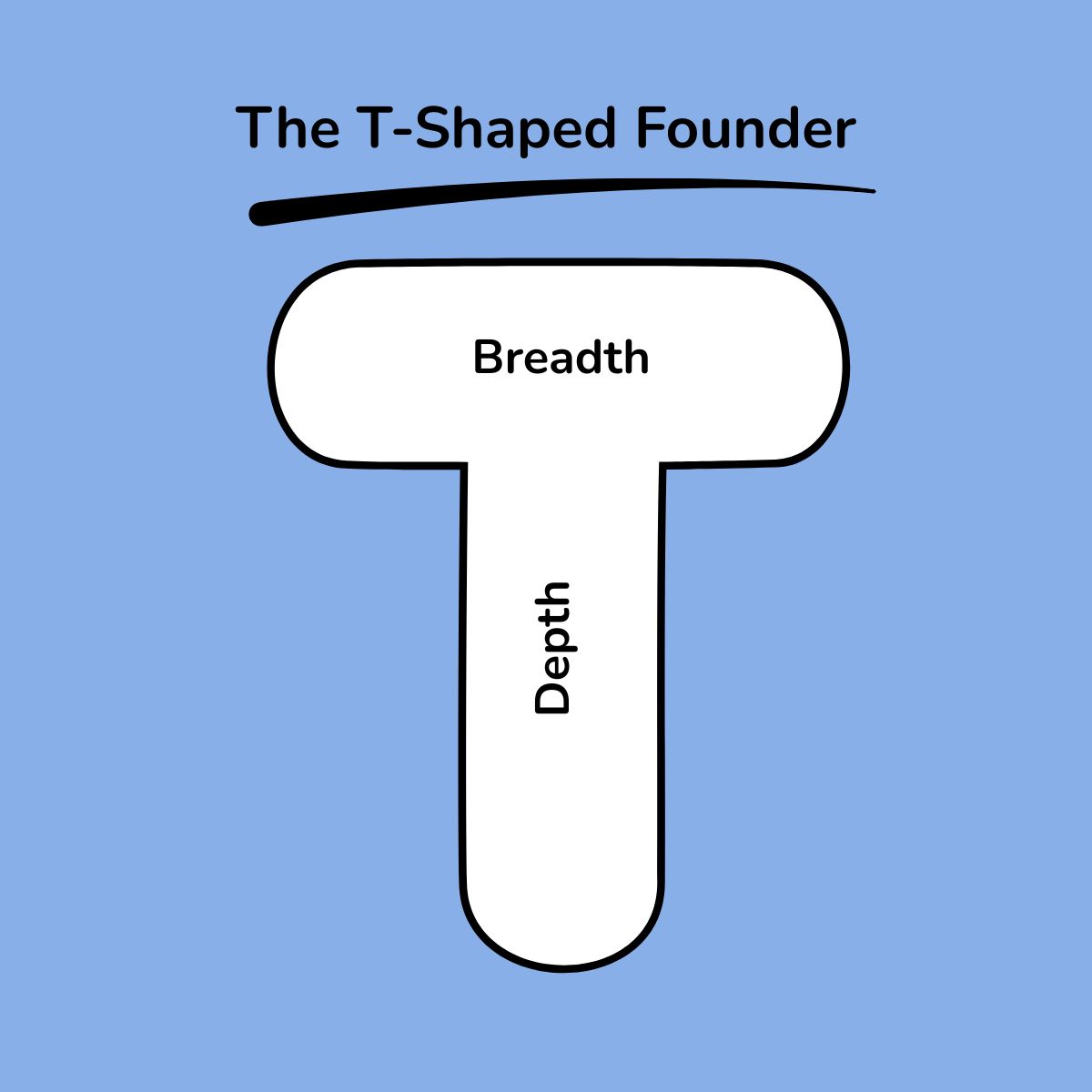
Think of your entire business knowledge as the letter T. This simple structure helps you allocate your most precious resource—your time—to the areas that matter most.
The Vertical Bar: Your Superpower (Depth)
The vertical bar represents deep expertise in one area—the primary reason customers pay you. Think of this as your competitive edge: recipe development for baking, product formulation or branding for cosmetics, nutrition coaching for diet and wellness, or superior copywriting/strategy for e-commerce. As a beginner, you must invest heavily here; this is your core strength and the reason people pay you.
The Horizontal Bar: Minimum Viable Knowledge (Breadth)
The horizontal bar represents basic, working knowledge across the six essential pillars of every business: Product, Marketing, Sales, Finance, Operations, and Business Management. You don't need to be an expert in these areas, but you need to know enough to set up the basics, spot a bad hire, or understand a financial report. The goal is competence, not mastery.
Here’s how to build the horizontal bar quickly.
1. Marketing & Sales: The Revenue Engine
The most common failure point for founders is thinking they’ll build it and customers will come. You must understand how to attract attention (Marketing) and convert that attention into money (Sales).
Marketing Focus: Learn the basics of Search Engine Optimization (SEO), focusing on technical speed, visual discoverability, and creating content that solves specific user problems.
Sales Focus: Master the art of the discovery call. Learn to ask open-ended questions and focus 80% of the conversation on the customer's pain points, not your product's features.
2. Finance & Operations: Keeping the Lights On
Many founders avoid the back-office side, but your business is only as healthy as its cash flow.
Finance Focus: You need to understand your Unit Economics (how much it costs to deliver your product one time) and keep a simple profit-and-loss sheet. Skip complex modeling and focus on tracking every dollar.
Operations Focus: Learn how to set up simple, repeatable Standard Operating Procedures (SOPs). This might be using a project management tool (like Trello or Asana) to define how you onboard a client or how you ship a product. When you eventually hire, these SOPs are what you hand over.
3. Business Management & Legal: Strategy & Protection
Business Management:
Business Planning: Every business starts with a plan; effective management begins here. Learn to set clear goals, map out your growth, and organize your resources.
Leadership: Focus on team structure and steering your strategy.
Legal: Protect your brand. Understand basic Intellectual Property (IP) and ensure you are compliant with industry regulations.
Where to Find Your Horizontal Training (Free Resources)
You should never pay for a general business degree just to get started. The training for your horizontal bar should be fast, free, and actionable. Here are free excellent resources for high-impact learning:
For Marketing & Sales Fundamentals:
HubSpot Academy: Offers free certifications in Digital Marketing, Content Strategy, and Inbound Sales. These are practical and immediately applicable.
Google Skillshop: Excellent, short courses on things like Google Analytics and search ads—essential for understanding web traffic.
For Financial Literacy & Business Acumen:
Khan Academy: Their free courses on basic accounting, economics, and finance are perfect for understanding the numbers without needing an accounting degree.
Small Business Administration (SBA): The U.S. SBA offers free online courses and webinars specifically designed for new founders on topics ranging from business planning to debt management.
For Strategy, Management & Leadership:
Business Management 101 (YouTube Course): A comprehensive series covering the core principles of business management and effective leadership.
How to Write a Business Plan (YouTube Guide): A practical, step-by-step walkthrough on structuring your business plan.
MIT OpenCourseWare (Getting Things Implemented): A practical course focused on the intersection of strategy, leadership, and operational performance. Their free courses provide world-class, deep insights into ethical leadership, team dynamics, and operational management.
The goal isn't to graduate from these programs; it’s to collect minimum viable knowledge so you can manage a specialist or execute the task poorly yourself—which is better than doing nothing at all. A startup thrives on momentum, not perfection. Executing even with imperfect knowledge forces you to test your assumptions, gather real-world data, and identify your actual skill gaps. Stalling to achieve total mastery is often just a form of procrastination. Start learning the horizontal today, and watch your confidence (and your startup) grow.
Jun 07, 2026 by Nasir Nor
The T-Shaped Founder